
Trade Show and Congress Management: Run Large-Scale Events Smoothly
Multi-hall sessions, thousands of attendees, exhibitor lead capture: Actiolife's solutions, planning tips, and event types for trade shows and congresses.
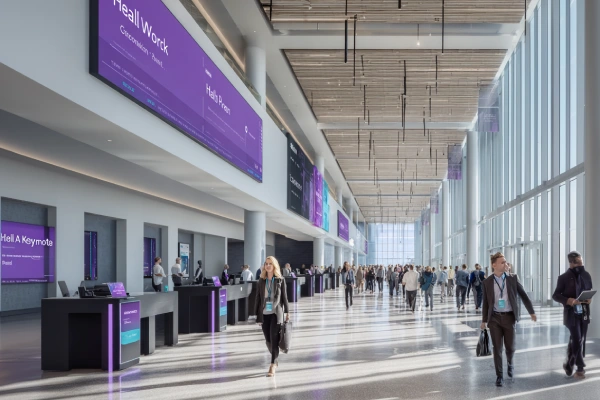
In the greenroom, a speaker is rehearsing before stepping on stage. At the main entrance, hundreds of attendees scan their QR codes and pick up their badges. Four parallel halls launch concurrent sessions. On the trade-show floor, exhibitors scan interested visitors and drop them straight into their lead pools. Off to the side, sponsor booths are being set up; final touches are being made on the VIP table for tomorrow’s gala dinner.
Trade shows and congresses are the most operationally complex category of corporate events:
- Multi-day, multi-hall structure with parallel sessions
- Thousands of attendees — a mix of visitors, speakers, exhibitors, and sponsors
- Heavy pre-registration traffic — capacity and flow management are critical
- Lead capture — the backbone metric for exhibitor ROI
- Multiple queues — every entry point requires second-by-second decisions
In this article we cover the solutions Actiolife provides for managing large-scale events, the organizational considerations that matter, and the event types this model is built for.
What Makes Trade Shows and Congresses Different
Unlike a corporate meeting or a private invitation, managing a trade show or congress is a resource coordination problem. Multiple roles, halls, sessions, sponsors, and exhibitors must operate in concert within a single event.
When hundreds of attendees are involved, a single manual step turns into a queue lasting minutes — the more automated the system, the more professional the attendee experience.
Typical building blocks:
- Main program — opening keynote, headline talks, panel sessions
- Parallel sessions — concurrent content across multiple halls
- Workshops — limited capacity, pre-registration required
- Exhibition floor — exhibitors, product demos, lead capture
- Social program — networking breaks, gala dinner, awards ceremony
What Actiolife Provides for Large-Scale Events
Actiolife’s Organizer bundle is built specifically for events at this scale. Below are the core modules and their role in large events.
Pre-registration management
Half of a trade show or congress’s success is decided before the doors open. Who registered, how many will attend, which sessions are full, which workshops still have seats — these are the foundation of capacity planning.
Actiolife’s pre-registration module offers:
- Customizable forms — organization, title, interests, session selection
- Email + SMS confirmation flows
- Approval / rejection workflow when manual review is required
- Ticket- or session-based capacity — auto-close when capacity fills
- Embeddable widget for your own site — branded registration screen
Multi-hall, multi-session program
Actiolife’s event program module is the spine of the congress. The system is built around three concepts: halls, sessions, and speakers.
- Hall management — capacity, location, color coding per hall
- Session calendar — drag-and-drop time and hall assignment
- Conflict detection — the same speaker cannot be assigned to two halls at the same time
- Agenda items — a mini-program of panels/talks within a session
- Speaker profile — photo, bio, social links
- Bulk shift — when one session runs 30 minutes late, all subsequent sessions can cascade
Public participant page
Every congress has its own public program page at actiolife.com/program/[congress-code]. Attendees use this page to:
- See the live program flow
- Tap into a session for speaker details and bio
- Add favorite sessions to their own calendar via iCal export
- Get hall directions on mobile
Fast check-in and on-demand badge printing
Thousands of attendees need to clear the main entrance in seconds. The classic "find the name on a list" approach collapses at this scale. Actiolife's flow:
- Attendee scans their QR code
- The system sends a personalized badge to the thermal printer — roughly 25 seconds
- VIP / Press / Sponsor tags appear automatically on the staff screen
- For unregistered walk-ins, a self-registration screen kicks in
No pre-printed badges, no manual lookups — everything is instant and personalized.
Exhibitor and lead management
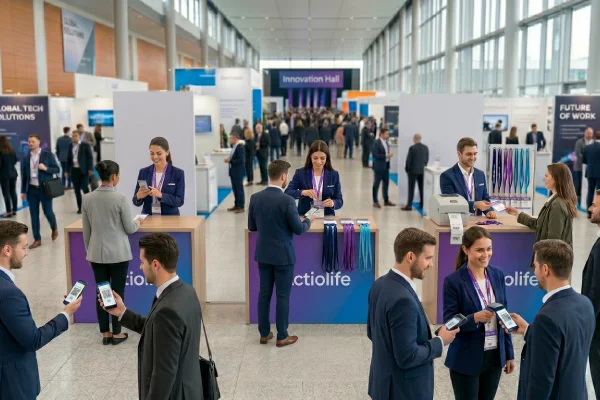
For exhibitors on the trade-show floor, the single most critical metric is lead count. Business-card collection is a method long used but increasingly weak — cards get lost, the product interest is forgotten, and follow-up takes days.
Actiolife's flow:
- The visitor's badge QR is scanned by the exhibitor staff with a phone
- On the screen, product/service categories the visitor is interested in are selected
- A conversation note is added — or left blank
- The lead appears instantly in the company's panel
- After the event, exported to Excel or CRM
Sponsor and VIP welcome
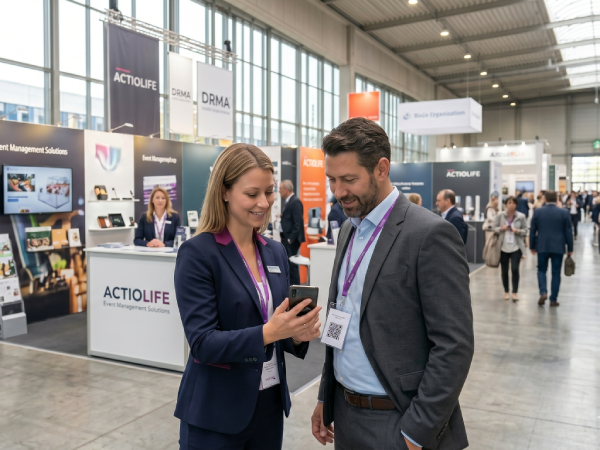
Sponsor relationships are the financial backbone of large events. Actiolife manages sponsor profiles, their position on the floor plan, and special tags for sponsor-linked guests.
VIP and Press identification: when these guests scan in, a prominent alert appears on the staff screen. Reception identifies priority guests without consulting any list, delivers a tailored welcome, and directs them to their gala table.
Sponsor visibility benefits as well: each sponsor gets a unique QR code, visitor touches, a lead pool, and a post-event report.

Email and SMS campaigns
When you have multiple attendee segments, communication must be segmented too:
- Invitation campaign — to the invited registrant pool
- Reminders — to non-respondents at T-7 / T-3 / T-1
- Confirmation — sent automatically after registration completes
- Workshop reminder — only to those who registered for a workshop
- Post-event survey — to those who actually attended
- Lead follow-up — to exhibitors’ target lists
Reporting and analytics
When the event ends, the next job is proving how successful it was. Actiolife’s reports include:
- Per-hall attendance rates — capacity vs. actual
- Per-session popularity analysis — what topics drew crowds
- Lead conversion reports — by exhibitor
- No-show rates — planning data for next year
- Feedback summaries — NPS, open-ended responses
What to Watch For When Running a Trade Show or Congress
The software catalog is one half — the planning details matter just as much. Critical points from experience.
Capacity and flow planning
- Predict peak times: registration spikes 09:00–10:00; lunch queues swell 12:15–12:45
- Reserve spare capacity: even with a full hall, expect 5–10% standby
- Wayfinding signs and digital displays — a confused attendee at a large venue rarely returns
Speaker and content logistics
- A greenroom is mandatory — speakers rehearse and check audio there
- Test AV equipment before the day, not on the day
- Collect presentation files in advance — there will always be a speaker showing up with a USB at the last minute
- Backup deck: the previous version of every talk on the organizer’s laptop
Badge production infrastructure
- Thermal printer count: 2 printers for 500 attendees, 4–6 for 2,000
- Card stock next to every printer — running out mid-congress doesn’t look professional
- Spare batteries and chargers — long congress days drain tablets and phones
Attendee experience and queue management
- Fast lane for attendees who completed online check-in
- Backup language support — at least two languages at international congresses
- Mobile program access — QR-to-mobile, not a printed agenda
Lead capture and sponsor ROI
- Train exhibitors beforehand: how to scan the badge QR, what notes to capture
- Define a lead quality metric: not just count — tag A/B/C quality
- Send post-event lead lists within 48 hours — before the lead goes cold
Practical tip
For large events, a single coordination dashboard is critical. Actiolife's real-time panel shows the organizing team — on a phone — the count of guests inside, hall occupancy, missing speakers, and lead traffic at a single glance. Radio coordination, messages lost in WhatsApp groups, and "who's where now?" questions drop sharply.
What Kinds of Events Is This Model For?
Actiolife’s large-scale event modules are built for the event types below.
Sector trade shows
- B2B fairs — industry, machinery, food, textile
- Consumer fairs — furniture, home textile, personal care
- Specialty fairs — health tech, finance, agriculture
- Education fairs — university recruiting, study abroad
- Career fairs — matching employers and job seekers
Congresses and conferences
- Medical and healthcare congresses — annual national meetings of associations
- Academic conferences — universities and research institutions
- Technology conferences — software, AI, fintech summits
- Industry summits — marketing, sales, HR
- Legal and regulatory congresses — tax, employment law, accounting
Annual association and chamber events
- Professional chamber general assemblies
- NGO congresses
- Union annual meetings
- Sports federation yearly events
Training and development events
- Multi-day training camps
- Summer schools and workshop series
- Certification programs — opening and closing events
The common thread: multi-layered programs, high attendee counts, a sponsor / exhibitor layer, and comprehensive reporting needs.
Manage Your Trade Show or Congress Professionally
The success of a large-scale event depends as much on the management infrastructure as on the content. Months of planning produce value in minutes on the day — if the system is ready.
Actiolife’s Organizer bundle brings trade-show and congress management onto a single platform:
- Pre-registration — customizable form, capacity management, approval flow
- Program management — halls, sessions, speakers, agenda items
- Public attendee page — mobile program with iCal export
- Check-in and badges — second-fast QR entry, on-demand printing
- Exhibitor lead — instant lead pool via QR scan
- Sponsor and VIP management — special tags and welcome flows
- Email + SMS campaigns — segmented communication
- Real-time reporting — organizer panel, sponsor ROI
Whether it’s a 500-person academic conference or a 10,000-person industry trade show — you stay in control of every step from planning through post-event reporting.